


Why Yoga Works Differently for Men Under Stress

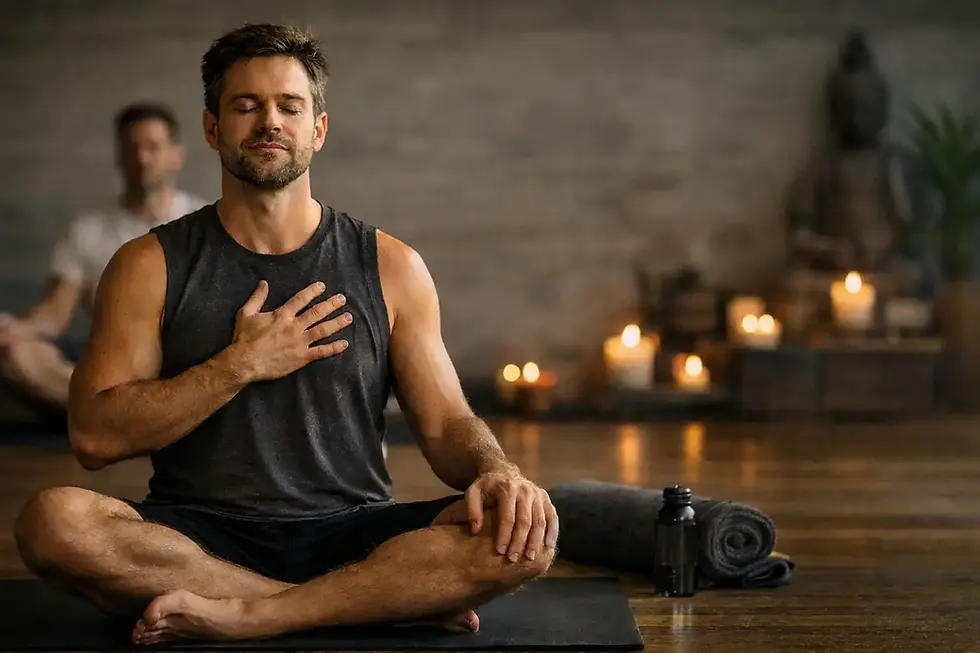
A gentle, grounded guide to how yoga, breathwork, and embodied practice help men release tension, reconnect with their bodies, and find calm in a world that rarely offers it.
Most men carry stress quietly. It sits building up in the body. It shows up as restless sleep, a short temper, or a body that feels more like an obligation than a home. And because men are often taught to push through discomfort rather than feel it, stress compounds. It layers, getting harder and harder to break away.
Yoga offers something different. Not a workout. Not another performance metric. A space to slow down, breathe, and feel what your body has been holding. A yoga practice gives you tools to reduce stress at the root, not by forcing calm but by creating the conditions for your nervous system to remember it.
This is yoga for men seeking stress relief beyond stretching. This practice meets you in the tension and helps you soften from the inside out.
How Men Experience Stress Differently
Men and women process stress through different biological and social pathways. Research published in Current Opinion in Behavioral Sciences found that oxytocin, a hormone closely linked to stress regulation, operates in a sexually dimorphic way. Stress activates oxytocin neuron activity more strongly in females, driving them toward connection and social support. In males, this buffering response is weaker (Bowen & Neumann, 2018). The result is that men are more likely to sit alone with stress. They absorb it quietly. They carry it in their bodies rather than sharing it with others.
A qualitative study by Stephen K. McKenzie, published in Men and Masculinities, explored how men talk about stressful situations. The findings showed that men use partial disclosure and strategic silence to hide vulnerability, often performing composure while internally overwhelmed (McKenzie et al., 2018). This isn't a personality flaw. It's a learned pattern shaped by social conditioning that pushes stress deeper into the body over time.
If you recognize yourself in any of the following, you're not alone. Most men under chronic stress will:
Withdraw and isolate rather than seek connection or emotional support
Minimize or dismiss what they're feeling, even to themselves
Hold tension in the body through clenched jaws, tight shoulders, shallow breathing, and chronic lower back pain
Express depression through physical symptoms like fatigue, headaches, chest tightness, and digestive problems rather than sadness
Turn to numbing behaviors like overworking, drinking, screen time, or emotional shutdown
Delay seeking help until symptoms become severe or physical health breaks down
That last point is well documented. A landmark study by Lisa A. Martin and colleagues, published in JAMA Psychiatry, found that when alternative, male-typical symptoms like irritability, aggression, risk-taking, and substance use were included alongside traditional criteria, the gender gap in depression rates disappeared entirely (Martin et al., 2013). Men weren't experiencing less depression. They were expressing it differently.
A systematic review by Zac E. Seidler and colleagues, published in Clinical Psychology Review, confirmed that masculine norms around stoicism and self-reliance create significant barriers to help-seeking for depression in men. Many men struggle to recognize depressive symptoms in themselves and delay support until physical health deteriorates (Seidler et al., 2016).
None of this means men feel less. It means the stress has fewer places to go. It stays in the body. It accumulates. And over time, it shapes how a man relates to himself, to others, and to his own capacity for rest and pleasure.
Yoga doesn't ask you to talk about it. It asks you to breathe through it, move through it, and slowly let your body release what it's been gripping.
Does Yoga Really Help With Stress and Anxiety?
A 2018 study led by Jennifer West and colleagues, published in the Journal of Clinical Psychology, found that participants practicing hatha yoga three times a week for four weeks experienced significant reductions in perceived stress, depression, and anxiety compared to controls (West et al., 2018). A 2020 study published in the International Journal of Yoga looked specifically at men and found that yoga stretches lowered cortisol levels and had a positive effect on parasympathetic nerve activity, the branch of the nervous system responsible for rest and recovery (Vadiraja et al., 2020).
These aren't outlier results. A 2024 systematic review by Tamara Siegfried and colleagues in the Journal of Clinical Medicine confirmed that yoga produces measurable physiological changes that reduce stress, including decreased muscle tension and improved neuromuscular efficiency during physical postures (Siegfried et al., 2024).
Yoga works because it doesn't target stress from one angle. Physical postures release what the body is holding. Breathing exercises calm the nervous system. Staying present in a pose teaches the brain a new way to respond to pressure. Instead of reacting automatically, you learn to pause, breathe, and choose to find comfort in the uncomfortable. That combination is what makes yoga one of the most effective relaxation techniques available for long-term stress relief.
This is not a quick fix. It's a retraining. And over time, the benefits of a regular yoga practice extend well beyond the mat.
Why Yoga Is a Powerful Stress Relief for Men
Stress relief for men rarely looks like rest. It looks like more effort, more distraction, more pushing through. Yoga reverses that pattern. It works by giving your body and brain permission to stop bracing, stop gripping, and start releasing what was never yours to carry.
It Teaches Your Nervous System to Relax
The nervous system doesn't distinguish between types of stress. Whether you're sitting in traffic, meeting a deadline, or holding a difficult yoga pose, the body's stress response is the same: increased heart rate, shallow breathing, elevated cortisol, and muscle tension.
Yoga interrupts that pattern. By pairing physical postures with slow, steady breath, you send signals to the brain that say, "You can stand down." Research by Andrea Zaccaro and colleagues, published in Frontiers in Human Neuroscience, found that slow-breathing techniques such as pranayama increase alpha and theta brainwave activity, calming the autonomic nervous system and significantly reducing stress reactivity within a single session (Zaccaro et al., 2018).
The more you practice this response, the more natural it becomes. You begin to manage stress not by thinking your way out of it but by breathing your way through it. Over time, this reduces stress in everyday life and establishes a calmer baseline in the nervous system. The brain starts to form new habits. Calm becomes more accessible.
It Gets You Out of Your Head
Men often live from the neck up. Planning. Strategizing. Problem-solving. Overthinking. Yoga brings awareness back into the body. When you focus on how your feet press into the ground or how your ribs expand as you inhale, you return to the present moment.
This is one of the most overlooked mental benefits of yoga. It's not about stopping thought. It's about redirecting attention. The practice asks you to focus on sensation, breath, and alignment. That shift alone can relieve stress and reduce the mental noise that feeds anxiety.
Research by Tim Gard and colleagues, published in Frontiers in Human Neuroscience, found that regular yoga practice strengthens prefrontal cortex activation, the area of the brain responsible for emotion regulation and decision-making. Over time, the brain's automatic stress response weakens and is replaced by a more intentional pause (Gard et al., 2014). This is one of the most valuable insights from modern neuroscience: the stress response is a habit, and yoga is one of the most effective ways to retrain it.
If overthinking is something you struggle with, yoga is one of the most grounding practices available. Even something as simple as five minutes in child's pose with slow, steady breathing can quiet the mind enough to ease stress and interrupt the spiral. The breath becomes an anchor. The body becomes a place to rest your attention, rather than letting it loop.
It Creates Space for Emotions Without Forcing Them
Many men don't have a safe container for their emotions. Yoga offers one. Not through conversation, but through movement. A deep hip opener can surface grief. A long hold in a forward fold can release frustration. A restorative pose can bring unexpected tears.
You don't have to understand it. You just have to let your body do what it needs to do. This is how yoga supports emotional regulation and mental health: by giving the body permission to process what the mind has been avoiding. That emotional release is part of why many men report feeling lighter, clearer, and more present after practicing yoga.
Which Yoga Is Best for Reducing Stress?

Not all yoga is the same. Some styles are physically intense. Others focus almost entirely on stillness. The best yoga for stress relief sits somewhere between movement and rest, effort and surrender.
Hatha Yoga
Hatha yoga is a slow, deliberate practice that focuses on physical postures held for several breaths. It's grounding, accessible, and one of the most effective styles for releasing tension in the body. If you're new to yoga or returning after a long break, hatha yoga is a strong place to start.
The pacing allows you to connect with each pose rather than rushing through a sequence. You build muscle strength while also practicing patience. For men who carry tension in their upper body and lower back, hatha yoga addresses those areas with care.
Yoga Nidra
Yoga nidra is sometimes called yogic sleep. It's a guided deep-relaxation practice performed lying down, typically in corpse pose. You remain still while a voice leads you through layers of awareness, scanning the body, observing the breath, and resting in a state between waking and sleep.
A 2020 study found that practicing yoga nidra for just 11 minutes per day over 30 days reduced stress levels, improved sleep quality, and boosted overall well-being. The benefits remained six weeks later.
Yoga nidra is a form of meditation, but it doesn't require you to sit still and clear your mind. The guidance does the work. Your only job is to lie down and listen. For men who find sitting meditation difficult, yoga nidra offers a different entry point into deep relaxation.
Restorative Yoga
Restorative yoga uses props like bolsters, blocks, and a folded blanket to support the body in gentle poses held for five to fifteen minutes. There's almost no muscular effort involved. The goal is total surrender.
This kind of practice sends a clear message to the nervous system: you are safe. For men who are constantly running in high-alert mode, restorative yoga can feel like a reset button.
Embodied and Erotic Meditation
There's a category of practice that most stress relief guides won't mention, not because it doesn't work, but because it's misunderstood. Erotic, JOI, and guided spiritual meditations use breath, voice, and body awareness to help men release tension that runs deeper than muscle tension. The kind stored in the nervous system from years of emotional suppression, performance pressure, and disconnection from pleasure.
These practices are not about stimulation for its own sake. They're rooted in the same principles as yoga nidra or breathwork: presence, intention, and conscious awareness of what the body is holding. The difference is that they include erotic energy as part of the release, because for many men, that energy is where the deepest stress and the deepest calm both live.
Nude Yoga offers a private, guided practice where the absence of clothing becomes an invitation to drop pretense and meet the body with honesty. Sacred Intimacy goes further, offering men a path into conscious erotic connection through live ritual and recorded meditations like The Garden of Love and Stay After Class. Each one is designed to help the body soften, the breath deepen, and the mind go quiet.
How Yoga Retrains the Brain's Stress Response
Most stress relief advice tells you to think differently. Reframe the situation. Change your perspective. But stress doesn't live in your thoughts alone. It lives in your nervous system, your breathing pattern, and the tension you carry without realizing it. Yoga works at that level. It retrains the body's automatic reactions so that calm becomes something your system knows how to find on its own, even under pressure.
It Interrupts the Automatic Alarm
Every stress response follows the same physiological script: faster breathing, elevated cortisol, muscle tension, and anxious mental chatter. It doesn't matter whether the trigger is a work deadline or a deep hip stretch. The body fires the same alarm. Over time, this reaction becomes automatic. Muscles tighten before you notice. Anxiety arrives before there's anything to be anxious about.
Yoga interrupts that loop by placing you in mild discomfort and asking you to stay calm inside it. When you hold a warrior pose while your left thigh burns, or keep your arms overhead while your shoulders want to drop, the brain sends the same alarm signals it would during any stressful situation. But instead of reacting, you breathe. You soften. You stay.
That choice, calm inside discomfort, is what begins to rewire the stress response. Try it yourself: come into a standing fold forward with your feet hip-width apart, let your head hang heavy, and breathe into the back of the ribs. You'll feel the pull in your hamstrings and the urge to tense. Practice relaxing into it instead. That is the retraining.
It Rewires the Brain Over Time
Research shows that regular yoga practice leads to significant reductions in cortisol levels and anxiety. The brain's prefrontal cortex, responsible for decision-making and focus, becomes more active. The amygdala, the brain's fear center, becomes less reactive. The automatic stress response weakens. A slower, more grounded response takes its place.
This is why practicing yoga changes more than your flexibility. It's stress management at the level of your nervous system. Every time you choose to stay in a pose and breathe instead of brace, you're teaching your brain that discomfort doesn't have to mean danger.
The additional benefits compound over time. Emotions that once felt overwhelming start to feel more manageable. Stressful situations that used to trigger shutdown or reactivity now feel manageable. Your well-being improves not because life gets easier, but because your nervous system stops treating everything like an emergency.
It Moves From Effort Into Surrender
The deepest part of the retraining happens when you stop moving. Yoga and meditation are natural partners. Movement opens the body. Stillness settles the mind. When practiced together, they create a state of awareness and deep relaxation that supports stress relief long after the session ends.
You don't need to sit cross-legged in silence. Even five minutes of resting in corpse pose after your practice is a form of meditation. Lie with your arms at your sides, palms facing up, and let the body integrate what it just moved through. You can also practice meditation in a seated position, a kneeling position, or walking slowly with bare feet flat on the ground. The form matters less than the intention: to stop doing and let the body rest.
Cat cow pose is another powerful bridge between movement and stillness. Begin on all fours, and as you inhale, let your belly soften toward the floor. As you exhale, round your spine and let your head hang. Move slowly between these two shapes, matching each breath to the movement. After a minute, come into child's pose. From the kneeling position, fold forward and extend your arms in front of you. Let your forehead rest on the mat. Stay for as long as your body wants. This simple sequence, cat cow pose flowing into child's pose, is one of the most effective ways to relieve stress and signal to the nervous system that it's safe to let go.
Yoga nidra takes this further. You lie down, close your eyes, and a voice guides you through layers of relaxation. There's nothing to figure out. Your only job is to listen and allow your body to soften. For men carrying long-term stress and anxiety, this kind of guided resting practice can feel like the first real pause they've had in months.
Guided Meditation Beyond the Mat
For men who want to explore meditation as more than a post-yoga cooldown, guided practices offer a structured path into deeper presence.
Spiritual meditation, JOI meditation, and erotic meditation are all forms of guided experience that blend breath, body awareness, and intention. They invite you deeper into your own felt experience, bypassing the analytical mind and meeting you in sensation. These practices are not about performance. They're about returning to yourself. Softening the grip of overthinking. Letting your body lead.
At Love by Dove, meditation is woven into every offering, from Nude Yoga to The Garden of Love and Stay After Class. Each one is a guided experience designed to help you relax out of your head and back into your body.
Yoga as a Gateway to Deeper Embodiment
For some men, yoga becomes the beginning of a relationship with their own body, one that extends into how they experience pleasure, presence, and intimacy.
When you spend time on the mat learning to feel sensations without judgment, to breathe through discomfort, and to trust your body's rhythm, something shifts. The body stops being a machine and starts becoming a home.
This is where yoga intersects with deeper practices of embodiment. Nude yoga, for example, strips away the final layer of barrier between you and your body. It's not about exposure. It's about honesty. Practicing without clothing removes one more thing to hide behind and invites a quality of presence that's harder to access when you're performing comfort.
It's a common assumption that nude yoga or erotic yoga is inherently hypersexualized. That assumption misses the point entirely. These practices are rooted in the same principles as any yoga practice: breath, awareness, presence, and the willingness to be with what arises. The body is not a problem to manage. It is the doorway to deeper awareness.
A Practice That Meets You Where You Are
Yoga isn't about becoming someone new. It's about becoming more honest with who you already are. For men carrying stress, that honesty might look like admitting the body needs rest. It might look like breathing deeply for the first time in years. It might look like lying still in corpse pose and realizing there's nothing to fix.
The stress-relieving benefits of yoga are real. The research is there. But beyond the data, there's something simpler. A practice that asks nothing of you except your presence. A space where your breath is enough. Where your body is enough. Where are you enough?
If you've been curious about what a practice like this might feel like in a private, guided space, you're welcome to explore what we offer at Love by Dove. Every session is held one on one. Every experience is shaped by your pace, your comfort, and your intention.
No performance. No pressure. Just you, your breath, and a space to come home to your body.


Comments