


Where Yoga Meets Meditation: A Softer Way to Reconnect Mind and Body For Men
- Samantha Kennedy

- Feb 26
- 10 min read

Most men were never taught how to feel. You were taught to perform, push through, stay in your head. And at some point, your body became something you carried around rather than something you lived inside.
If you have landed here, something in you is ready for a different experience. Not harder. Not louder. Softer. Slower. More honest.
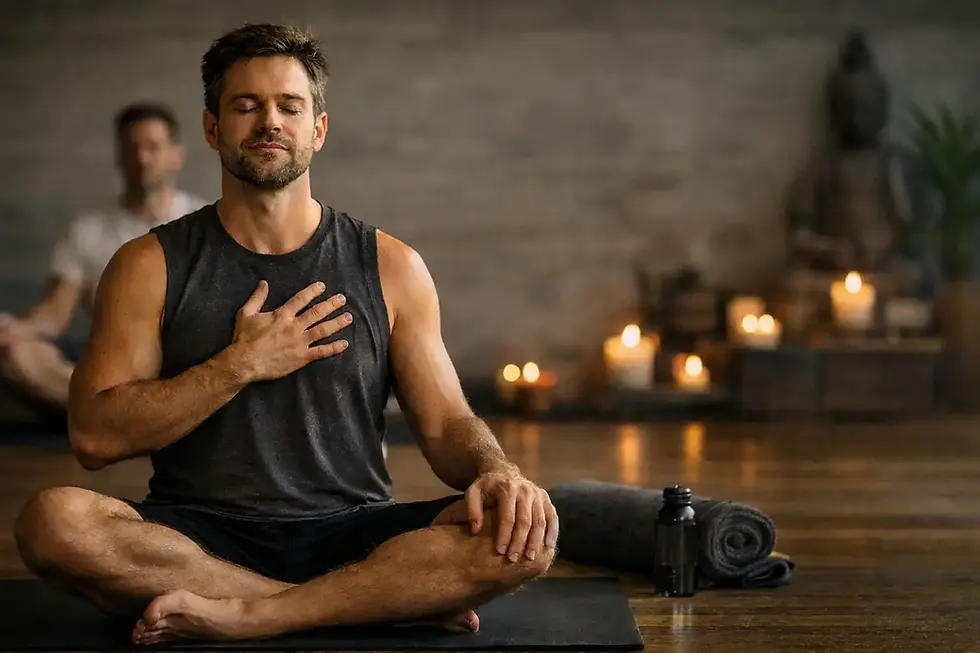
This is what yoga meditation offers. Not a fitness routine. Not a spiritual performance. A quiet, grounded way to find balance again through breath, movement, and stillness.
What Happens When You Stop Separating Yoga and Meditation
Most people treat yoga and meditation as two practices that happen to share the same room. You move on a mat, then you sit with your eyes closed. One is physical. The other is mental. That separation makes sense on the surface, but it misses the point entirely.
The word yoga comes from the Sanskrit root meaning "to yoke" or unite. In every major tradition where yoga was taught, the movement was never the destination. Asana practice was designed to prepare you to sit in stillness. Pranayama was designed to calm mental activity so you could concentrate. The postures and the meditation practice were always one process, not two.
When you begin to experience them as a single practice, something shifts. You stop performing the poses and start feeling them. You stop watching the clock during meditation and start noticing what your body is actually telling you. The difference between doing yoga and being present inside your yoga practice is the difference between going through the motions and actually coming home.
This is what yoga meditation means. Not yoga plus meditation. Yoga as meditation. Movement and stillness held in the same place, serving the same purpose: reconnecting you to yourself.
Why This Is a Gentler Way Back Into Your Body Than You Expect
If you are a man who has spent years living in his head, the idea of "reconnecting with your body" can sound vague or uncomfortable. You might associate it with something you need to force or perform your way through.
Yoga meditation works differently. It does not demand. It invites.
When you move through gentle postures, your nervous system begins to downregulate. Stress leaves the muscles. Your breathing slows. And by the time you sit in stillness, the mind does not have to fight to settle. It already started settling the moment you began to move.
This is why the combination is highly recommended for beginners who feel resistant to meditation alone. Sitting still with a racing mind is not a softer way to reconnect. It is often the hardest. But when movement comes first, the body does the calming work before you ever ask the mind to quiet down. The two practices support each other in a way that neither can do alone.
You do not need flexibility. You do not need experience. You do not need to believe anything specific. You just need the willingness to breathe, to move slowly, and to notice what you feel.
What Your Brain and Body Actually Experience During Practice
Yoga meditation is not just philosophy. There is real science behind why it works, and it is worth understanding what happens inside you when you practice.
Research studies show that yoga meditation increases alpha waves in the brain. Alpha waves are associated with calm alertness, a state where you are relaxed but present and aware. This is the opposite of the foggy numbness that comes from overstimulation or chronic stress.
In longer sessions or deeper practices like yoga nidra, theta waves also increase. These are linked to insight, creativity, and deep relaxation. They are the same brain patterns found in people who meditate on a daily basis for months and years.
The physical benefits are just as real. Research studies have found that consistent yoga meditation can lower blood pressure, decrease anxiety and depression, reduce chronic pain, and improve the overall quality of sleep. Your physical health shifts alongside your mental state. One does not move without the other.
More importantly, for men who feel disconnected, these changes affect your ability to be present. In conversation. In intimacy. In your own life. When your brain is calmer and your body is less tense, you show up differently. You feel more. You react less. The benefits are not abstract. They live in how you move through your days and how you connect with the people you care about.
How Breath Becomes the Bridge Between Movement and Stillness
If yoga is the doorway back into yourself, breath is the key.
Pranayama, commonly referred to as breathwork in the yoga tradition, is the practice of intentionally directing your breathing. It is one of the oldest meditation techniques taught across nearly every lineage and the most accessible tool you have for shifting your state.
When you breathe slowly and deliberately, your nervous system responds. Heart rate drops. Blood pressure decreases. The calming branch of the nervous system activates, and the stress response begins to soften. This is not a metaphor. It is measurable physiology.
Here is a simple technique to begin with. Find a comfortable position. Close your eyes. Breathe in through your nose for four counts. Hold gently for four counts. Exhale through your nose for six counts. Repeat five times.
That alone is a meditation practice. No mat required. No program. No mantra. Just your breath and your attention held in the same place for a few minutes.
For men who were never taught to breathe with presence, this can feel strange at first. But it is also where many practitioners report the biggest shift. Learning to breathe with awareness changes how you handle stress. It changes the quality of your focus. And it changes your ability to stay grounded during the moments in life that ask the most of you, including intimacy.
What Practicing Without Barriers Actually Feels Like
When most people hear the words "nude yoga," their mind jumps somewhere specific. That reaction is understandable. The practice has been stereotyped and reduced to something hypersexualized that has very little to do with what actually happens on the mat.
In reality, nude yoga is one of the most honest forms of moving meditation available.
Without clothing, there is nothing between you and sensation. No brand. No mirror performance. No fabric shaping how you perceive yourself. What remains is breath, feeling, and presence. The practice strips away distraction and returns you to something fundamental: what it actually feels like to live in your skin.
The difference between clothed and nude practice is not visual. It is sensory. The air becomes a point of focus. Awareness sharpens. Your ability to focus on what you feel rather than what you look like naturally deepens.
For men who carry tension, numbness, or shame around their physical selves, this kind of practice can be quietly life-changing. Not because it fixes anything. Because it reveals that there was never anything broken.
We offer private online nude yoga sessions for exactly this reason. Not as performance. As a guided space to breathe, move, and reconnect with your body in a way that feels safe, slow, and completely yours.
Different Ways to Soften Into Meditation Through Yoga
There is no single right way to meditate. What feels impossible for one person might be easy for another. What matters is finding a path that meets you where you are. Here are several approaches commonly taught within the yoga meditation tradition.
Mindfulness Meditation
You sit. You observe your thoughts without judgment. The goal is not to empty the mind but to develop a steady, kind awareness of what is already happening inside you. Mindfulness meditation is one of the most widely practiced forms today because it asks so little and offers so much. Over time, it builds emotional clarity and a natural sense of balance that carries into every part of your life. In this context, mindfulness is not a spiritual concept. It is a skill. And like any skill, it strengthens the more you engage with it.
Mantra Meditation
The word mantra comes from Sanskrit: "man" meaning mind and "tra" meaning instrument. Mantras are repeated words or phrases that anchor the mind and quiet the noise. Some mantras are taught in Sanskrit. Others are simple affirmations spoken silently. Repeating mantras during practice can enhance focus and peace. For many men, this technique offers a direct path to stillness by giving the restless mind something specific to hold onto.
Walking Meditation
Not all meditation happens sitting still. Walking meditation is a practice of slow, deliberate movement with full attention on each step. It is highly recommended for men who feel restless or have difficulty sitting for long periods with their eyes closed.
Body Scan Meditation
This calming technique guides your awareness through different areas, one at a time. You begin at the feet and move upward, noticing sensation and tension along the way. It builds insight into where you hold stress physically, which for many men is the first step toward releasing it.
Yoga Nidra
Sometimes called yogic sleep, yoga nidra is a guided practice done lying down. It brings you to the edge of sleep while keeping a thread of awareness alive. Practitioners often report deep rest and a meditative state that feels effortless. It is one of the most calming practices available for men dealing with insomnia or overstimulation. Many describe it as a spiritual experience, even if they have never used that word before. The body lets go. The mind lets go. And what remains is something quieter than both.
Guided Erotic Meditation
This belongs in the conversation even though it is rarely discussed in traditional programs. Guided erotic meditation uses breath, sensation, and presence to reconnect with pleasure and desire in a mindful way. It is not about stimulation for its own sake. It is about reclaiming your ability to feel, slowly and without performance pressure.
We created ourguided meditation experiences andthe Garden of Love as extensions of this work. They are rooted in the same principles as any meditation practice: breath, presence, and returning to yourself without judgment.
Loving-Kindness Meditation
Also known as metta in Buddhist tradition, this practice involves silently sending goodwill to yourself and others. It is a quiet way to develop compassion, decrease anxiety, and soften the inner critic that many men carry without realizing it.
When Anxiety Lives in Your Body and Your Mind at the Same Time
Many men carry anxiety they cannot name. It shows up as restlessness, difficulty sleeping, a short fuse, or a feeling of being permanently on edge. Sometimes it shows as numbness. Sometimes it shows as the inability to relax, even when nothing is wrong.
Yoga addresses anxiety through movement. Postures release stored tension. The asana practice activates the calming response. Physical engagement gives the brain something real to focus on, which interrupts anxious thought loops.
Meditation addresses anxiety through the mind. A regular meditation practice teaches you to observe anxious thoughts without reacting to them. Over time, it rewires your brain's response to stress. The patterns that once controlled you begin to lose their grip. You learn to meditate through the discomfort rather than running from it.
For most people, combining yoga and meditation produces stronger results than either one alone. Research studies consistently show that yoga meditation can decrease symptoms of anxiety and depression more effectively than a single-method approach.
If anxiety lives in your muscles, start with movement. If it lives in your thoughts, start by learning to meditate. If you are not sure where it lives, begin with both. Even ten minutes a day can shift the balance toward something calmer. Give yourself permission to relax into not having the answer yet. The practice will meet you.
How to Begin When You Have Never Done This Before
You Do Not Need to Be Ready. You Just Need to Be Willing.
Starting does not require experience, flexibility, or a perfect space. It requires one thing: willingness.
Start where you are. You do not need to sit cross-legged for an hour. Five minutes of breathing in a chair counts. Beginners do best when they remove the pressure to get it right.
Use breath as your anchor. If you do not know what to concentrate on, concentrate on your breathing. In and out. Slow and steady. That is enough.
Let movement come first. If sitting still feels hard, try walking meditation or a few gentle yoga postures. Let your yoga practice warm you up before asking your mind to be quiet.
Create a rhythm. Practice at the same time each day, even for a few minutes. Consistency matters more than duration. Not every session needs to be the same length. Some days five minutes is all you have. That still counts. You can practice alone or in a group meditation setting. What matters is that you keep showing up.
Find support if you want it. A guide, a course, or a private session can offer structure when you are just starting out. It is highly recommended for beginners who want a more personal experience. Our Reiki and energy work programs are one path. A private session is another.
What Changes When You Keep Coming Back
The real benefits of yoga meditation do not arrive as a single peak experience. They accumulate quietly over time, like warmth spreading slowly through a room.
Over weeks and months, you may notice that you meditate more easily. That you sleep better. That stress does not grip you the way it once did. That you can sit with discomfort, physical or emotional, without rushing to escape it. That balance returns to areas of your life where it had been missing.
Long-term practitioners show measurable changes in brain structure. Increased focus. Stronger emotional regulation. Greater self-awareness. Physical health improves alongside the shifts in mind and spirit. All the benefits of this work come not from a single session but from the quiet discipline of returning again and again.
And for men who engage with this practice as a path toward deeper intimacy and presence, the changes run even further. You discover that the ability to stay present during yoga is the same ability that lets you stay present with another person. The quality of attention you develop on the mat is the same quality of attention that transforms how you connect, how you listen, and how you touch. When you learn to meditate through your body, you learn to inhabit every part of your life more fully. The spirit of the practice follows you off the mat.
This is the real power of yoga and meditation combined. Not a dramatic before-and-after. A slow, steady return to your own aliveness. A softer way back to a body that has been waiting for you.
If you are curious about going deeper, we are here. Whether throughprivate yoga, a guided meditation, or a ritual designed for men ready to reclaim their erotic energy and go further still, the invitation is the same.
Slow down. Breathe. And discover what has been waiting for you all along.


Comments